
Search has changed. It’s no longer just about ranking in a list of ten blue links. Today, search engines are generating answers directly using artificial intelligence. That means your website isn’t just competing for clicks — it’s competing to be the source that AI systems choose to quote, summarise and trust.
If you run a business website — or manage them for clients — understanding how AI affects SEO is no longer optional. The good news? The fundamentals still matter. The difference is how we apply them. Let’s break this down clearly and practically, especially in the context of WordPress and Yoast.
Imagine search engines used to be librarians. Now they’re librarians with jetpacks and PhDs. So WHAT IS AI (in search terms) and how do it get there?
Think of AI as a super-fast pattern machine. Tools like OpenAI’s ChatGPT and Google’s AI systems read mountains of text and learn patterns in language. A “Large Language Model” just means: Big brain trained on ridiculous amounts of text. (I’m also using my PAT Testing business as an example of optimisation here.)
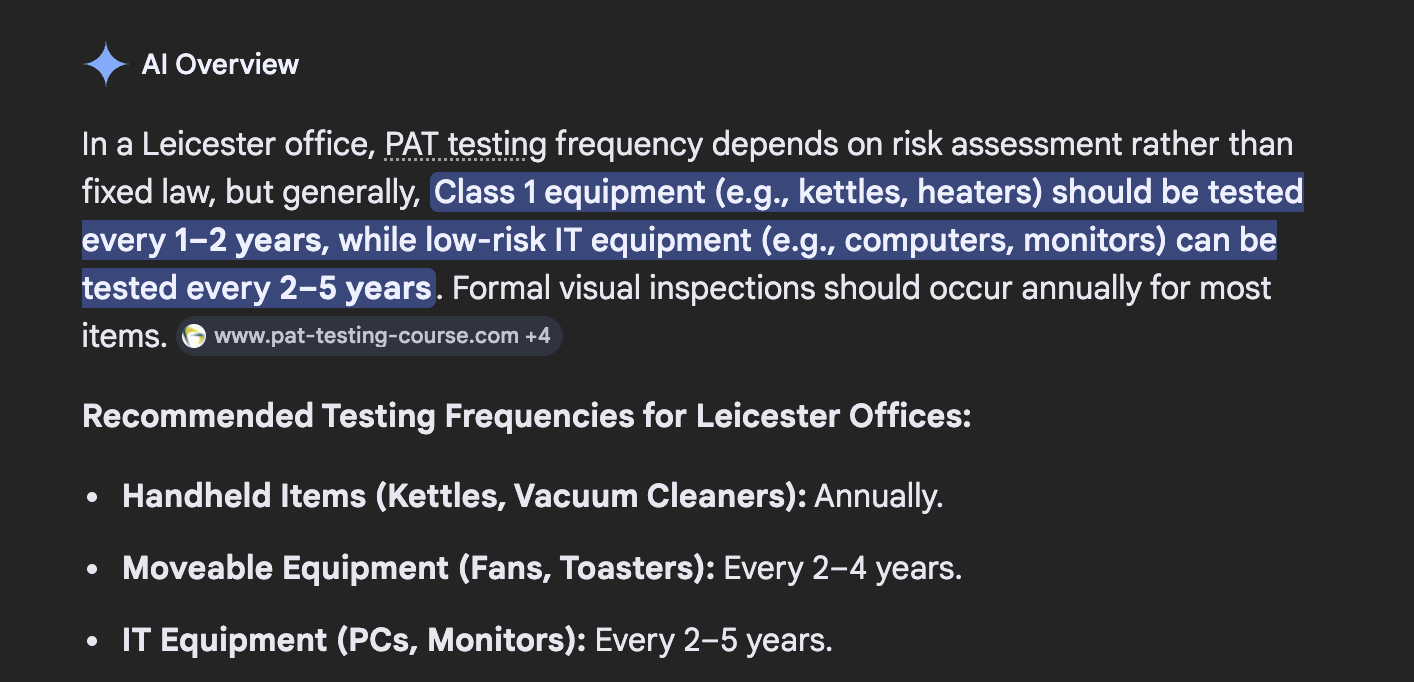
In search engines, AI is used to: Understand what people really mean (even if they type badly); Summarise answers; Predict related questions; and generate AI overviews at the top of results. So for example for your PAT Testing business, that means Google might summarise “How often should I PAT test in a Leicester office?” without sending the person to a website. The game just changed.
THE IMPACT OF AI SEARCH
Old search: User types → Google shows 10 blue links → user clicks one.
New search: User types → AI gives a full answer at the top → user might never click. Oops.
Tools like ChatGPT Search are becoming answer engines instead of link directories.
- They impact on your clients (and websites): with fewer casual clicks.
- More need to be the trusted source AI pulls from.
- More importance on clear, factual, structured content.
- Traffic may shrink in some cases. But higher-intent traffic (people ready to act) becomes more valuable. Ooh!
HOW AI SEARCH RESULTS WORK
Two nerdy phrases made friendly: >> Query fan-out… When someone asks “Do I need PAT testing for my café?” … AI silently asks 20 related mini-questions:
- What is PAT testing?
- Legal requirement in UK?
- Business types?
- Risk assessment rules?
- Frequency guidance?
Then it stitches those answers together. Retrieval Augmented Generation (RAG); This means the AI doesn’t just rely on its memory. It goes and fetches real documents from the web and builds an answer from them (which is a good thing for websites). So your blog post can literally become part of the material the AI “reads” to construct answers. That’s huge.
HOW SEARCH ENGINES TREAT AI-GENERATED CONTENT
Google does not hate AI content. Google hates: Thin content; Generic waffle; No expertise; No originality and; No real-world signals. If you use AI to write: “PAT testing is important for safety in workplaces.” That’s beige toast. If you use AI to help structure: “Based on 150 PAT tests we completed in Leicester offices last quarter…” (which is using those real world examples / maybe as you would have used a Case Study in the olden days OR… how you really should have been blogging…) Now we’re cooking.
Search engines look for: Expertise; Experience; Authority; And; Trust (often referred to as E-E-A-T). That means your clients’ real stories matter more than robotic content (which also rings true for the social media you should already be churning out).
CHARACTERISTICS OF COPY THAT RANKS FOR AI
AI loves structure. Think: Clear headings; Direct answers; FAQs; Bullet-style clarity; Short paragraphs; Definitions and; Specific numbers. Yoast in WordPress is already nudging you this way (with suggestions of): Proper H2s; Internal links; Meta descriptions; and; Readability – Are you doing these things? You’re not replacing SEO basics. You’re sharpening them. Example: Instead of: “We offer comprehensive PAT testing services…” Use: “How Often Should PAT Testing Be Done in a UK Office?” Then answer in 2–3 clear sentences immediately. That helps: Featured snippets; AI summaries; Voice search and; Chat-based search.
USING AI WRITING TOOLS
Different tools do different things. ChatGPT is: Good for structure, ideation, rewriting, outlining. But don’t forget that AI is a junior assistant. Not your brand strategist.
PROMPT WRITING (This is your new SEO superpower)
Bad prompt: “Write a blog about PAT testing.” BUT A… Better prompt is: “Please write me a 900-word blog post for a UK PAT testing business targeting small Leicester female led offices and creative businesses. Include a clear definition, legal requirements, frequency guidance, common myths, and a short FAQ section. Tone: professional but approachable. Thank you.” Specific in = useful out. You’re essentially becoming a director of robots.
USES OF AI FOR SEO (Beyond Writing)
This is where it gets fun for you as a digital marketer. AI can: Cluster keywords into topic groups; Generate FAQ schema ideas; Analyse competitor headings; Suggest internal linking opportunities; Rewrite thin content; Turn blog posts into social snippets; and; Summarise analytics patterns. Imagine uploading 50 blog titles and asking: “What content gaps exist?”. That’s not replacing your thinking. It’s accelerating it.
AI isn’t killing SEO. It’s shifting SEO from: “Rank for keyword” to “Be the clearest, most structured, most trustworthy source on a topic.” For you and your clients: Lean into real expertise; Use AI to enhance, not replace; Make pages answer-first; and; Structure content like it’s feeding both humans and machines. The internet is turning into a conversation instead of a directory. And frankly, for someone who builds websites properly instead of spraying keywords everywhere, that’s an advantage. The next frontier isn’t “How do I rank?” It’s “How do I become the source the machines quote?” That’s a much more interesting game and I’m here for it.